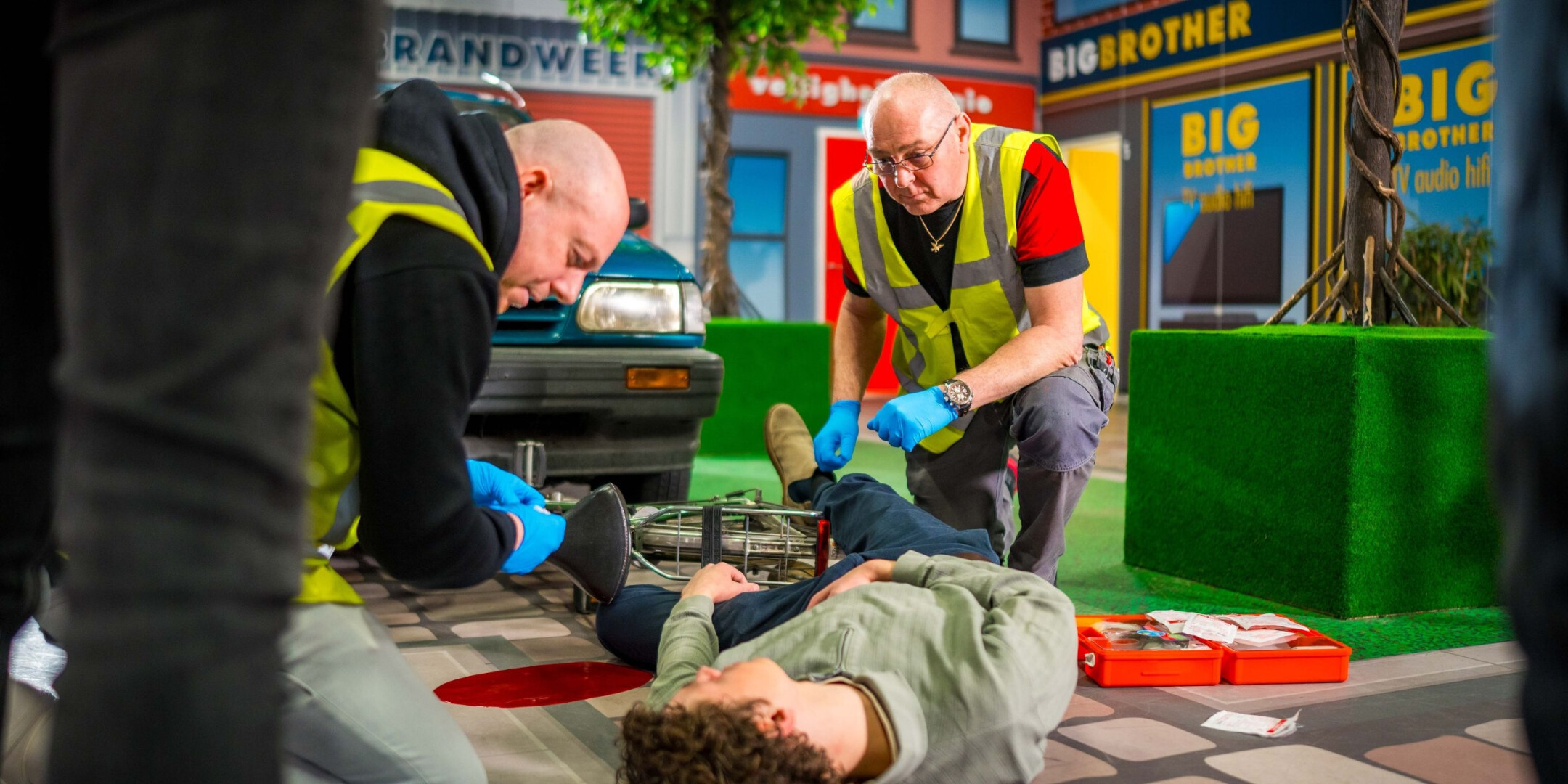
Emergency Response Training (ERT / BHV) Basic with E-learning
- Prepare online, learn by doing in practice
- Practise realistic emergency response scenarios
- Build confidence to act when it matters
Emergency Response Training (ERT / BHV) Basic with E-learning
The Emergency Response Training (ERT / BHV) Basic with E-learning is designed for organisations with English-speaking employees who need to respond effectively during workplace incidents. This blended training combines 3 hours of online preparation with a practical training day focused on realistic emergency scenarios. Participants do not just learn procedures—they develop the ability to act under pressure, which is what determines the outcome during real incidents.
What is an ERT / BHV Basic training with e-learning?
An ERT (Emergency Response Team) or BHV (Bedrijfshulpverlening) training prepares employees to handle incidents such as medical emergencies, fire and evacuation. Under the Dutch Arbowet, employers are required to ensure adequate emergency response capacity within their organisation.
In a blended format, theory is completed online, while practical skills are trained in person. This reflects how safety training is applied in practice: knowledge can be transferred digitally, but decision-making and behaviour must be trained physically.
Complies with workplace safety obligations under the Arbowet
Aligned with recognised frameworks such as NIBHV (Dutch Institute for Company Emergency Response)
Combines flexible theory with hands-on skill development
What you actually learn: from protocol to behaviour
Life-saving First Aid (ABCDE, CPR & AED)
Participants are trained using the ABCDE-method, the international standard for assessing and stabilising victims. This structured approach ensures that life-threatening conditions are identified and treated in the correct order.
In practice, instructors often see hesitation during the first critical actions, especially when using an AED for the first time. The training focuses on overcoming this hesitation and turning protocol into action.
Applying the ABCDE method in real-time situations
Performing CPR under time pressure
Using an AED without delay or uncertainty
Recognising deterioration in a victim’s condition
Fire response and evacuation under pressure
Fire incidents rarely follow a script. Smoke reduces visibility, communication becomes fragmented and people react unpredictably. During training, participants learn how to maintain control in these conditions.
Identifying fire risks in workplace environments
Making rapid decisions during evacuation scenarios
Using firefighting equipment effectively
Communicating with emergency services in English
Train as you Fight: what realistic training actually looks like
Theoretical knowledge often breaks down the moment stress is introduced. That is why Inprevo applies the principle “Train as you Fight”: training scenarios are designed to replicate the complexity of real incidents.
This includes:
Working in environments with reduced visibility (simulated smoke)
Handling multiple tasks at once (victim care and communication)
Dealing with hesitation, confusion and time pressure
Operating in English-speaking team environments
Instructors actively coach behaviour. For example, participants who hesitate during CPR or delay using an AED are guided to act decisively. This focus on stress inoculation ensures that responses become automatic rather than theoretical.
Why e-learning is used as preparation (and not as a replacement)
The 3-hour e-learning module is designed to reduce cognitive load during the practical training. By learning terminology, protocols and basic decision structures in advance, participants arrive better prepared.
This allows the practical day to focus on:
Applying knowledge instead of explaining it
Training behaviour instead of memorisation
Working through realistic scenarios with feedback
In practice, this leads to faster skill development and more effective use of training time.
From certification to competence
Completing the training results in certification for the theoretical component and qualification as an Emergency Response Officer. However, within modern safety standards, certification alone is not sufficient.
Skills such as CPR, evacuation leadership and communication under pressure decline without repetition. That is why annual refresher training is recommended to maintain operational readiness.
Focus on maintaining practical skills over time
Supports compliance and internal safety standards
Ensures continued ability to act during real incidents
Emergency Response certificate via a recognised training provider
After successfully completing both the e-learning and the practical session, participants receive an Emergency Response certificate from Inprevo. This demonstrates that they have completed the online theory and practised the core skills needed to respond to workplace incidents.
Inprevo is a Kiwa/NIBHV recognised training provider and a member of the Branchevereniging Bedrijfshulpverlening Nederland (BVBN). For open enrolment courses, we issue an Inprevo certificate as standard. For in-company training, we can also train towards an NIBHV certificate if required.
This way, participants combine flexible online preparation with practical, scenario-based training and certification that matches the needs and requirements of their organisation.
What will you learn during the Emergency Response Training (ERT/BHV) Basic with E-learning?
The E-learning student is trained in:
Life-saving First Aid (including CPR & AED)
Performing CPR and using an AED (Automated External Defibrillator)
Bringing a victim to safety
Assessing the victim's condition
Treating injuries
Firefighting and Evacuation
Firefighting and Evacuation alarming and evacuating people
Recognize fire and fire hazards; preparing for an eviction
Maintaining connections with aid organizations
Programme of the Emergency Response Training (ERT/BHV) Basic with E-learning
The training consists of two parts:
Online theory via E-learning
Practical session
Emergency Response certificate
Upon successful completion of both the E-learning and the practical session, participants receive the Emergency Response diploma.
In order to keep your knowledge and skills up-to-date we recommend an annual refresher.